Tuesday, February 5, 2013

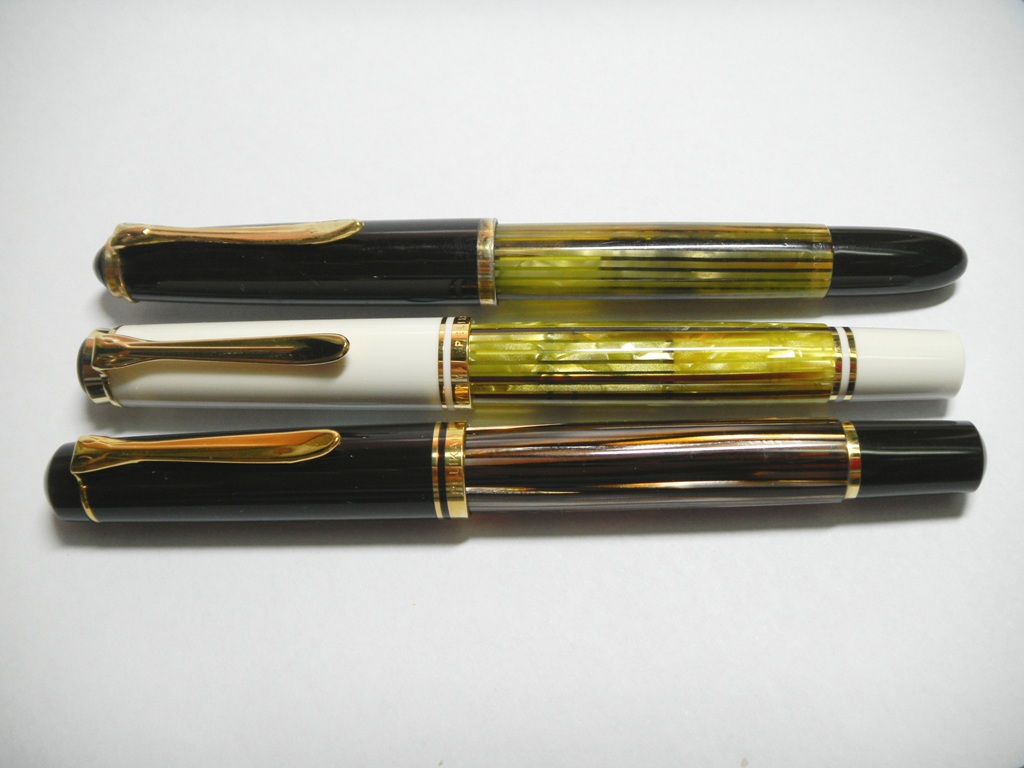
Three Pelikan Tortoises

DSCN4267x

Back in 2009 I was trying to decide on a birthday fountain pen.  I'm a Pelikan fan, and decided that I would save up for a Pelikan M400 White Tortoise with an F nib.  It had just been reintroduced as a regular (and no longer limited production) pen.  Prior to this my Pelikan flock was limited to M200s and M215s.  It's the same size as an M200, only with a 14k two-tone nib. I got it for a good price brand new from a Singapore-based seller, and was delighted to see how pretty it was.  Of course, since it was white, I read up on what inks I could safely use it with.  For this I use low-maintenance blues, greens, browns and blacks (nothing red or purple, to avoid possible staining).  To date it is my prettiest, blingy-est pen.

Last year my friend Hazel was streamlining her collection and put up her Pelikan 400NN Brown Tortoise for sale.  I took a deep breath and immediately went for it.  It's a 1950s model with a brown cap and piston knob.  The tortoise stripes are mostly green, with a few brown glints here and there.  The nib is a soft M, which I had gently stubbed by my friend J. P. so it would write with a bit more character.  At the base of the pen there is an almost invisible imprint "Pelikan 400 Gunther Wagner Germany". The cap clip is a little brassed, but it is a pre-loved pen after all.  I wasn't too worried about maintenance, since the 400NN pretty much had modern parts (no cork to replace on the piston). All it needed was for me to lubricate it, and that was easily done with a bit of silicone grease.
DSCN4238x

Top: Pelikan 400NN Brown Tortoise Middle: M400 White Tortoise Bottom: M250 Brown Tortoise

DSCN4244x

DSCN4256x

Now all I needed was a newer M400/M415 Brown Tortoise.  The chances of finding one at a price I could afford were slim, until my friend Onggie showed me one of his eBay scores.  "Hey, if you get tired of that, will you think of selling it to me?" I joked.  Little did I know that a few months later I'd actually get to own it, at its eBay acquisition price!  Of course when I saw it again, I realized that it was not the M400/M415 I thought it was, but the simpler and equally attractive M250 Brown Tortoise, a pen briefly issued by Levenger in 1997.  I identified it by the cap, which is domed with an engraved logo filled in gold, and has a double cap ring that says "Pelikan Germany".  The M400/M415 should have a double cap ring that says "Pelikan Souveran Germany".  Also, the M250's piston knob does not have a ring, while that of the M400/M415 has a double ring. As with the 400NN, the M250 Brown Tortoise has a brown cap and piston knob. My pen sports an old-style monochrome F nib.

DSCN4272x

Writing sample. (Click photo to enlarge.)

There is a special edition M600 version of the White Tortoise.  I love the size, but not the price.  The M415 Brown Tortoise, also a special edition,  is out of my budget, as is the much-rumored M800 version.  The M101N Tortoise is lovely and is, alas, out of my reach.  That won't stop me from admiring them, though.

I'm quite happy with my Three Tortoises.

Sunday, February 3, 2013

Buying Fountain Pen Inks in Manila

SAMSUNG
(Waterman inks photo by Cesar Salazar.)

More and more people are growing interested in using fountain pens here in Manila, as evidenced by the growing membership in our pen group Fountain Pen Network-Philippines.  For a long time Parker, Waterman, Cross and Montblanc were the only brands readily available in the local fountain pen market.  Now there are new brands available:  Lamy, Pelikan, Sailor, to name a few.  Waterman,Aurora, Cross and Rotring are now no longer being sold here, while Sheaffer recently reintroduced itself.  The local Pilot distributor sells only school pens, not the fine writing instruments, nor the ink.

I've compiled a list of stores that sell fountain pen inks, in bottles and cartridges as of 2013: (click on links to see directory info)

National Bookstore branches
- Parker, Lamy, Sheaffer, Inoxcrom (cartridges)

Montblanc branches - Makati (632) 813-3739, Powerplant Mall (632) 898-2347, Shangri-la Mall (632) 633-4636, Manila (632) 521-1140, Robinsons Place (632) 551-2095, Ayala Town Center (632) 850-5532

Scribe Writing Essentials - 3/F Eastwood Mall, QC.  (632) 900-0053.
- Herbin, Lamy, Sailor, Pelikan (4001 and Edelstein)

Cutting Edge (Greenbelt 5)
- Waterman

Times Trading
- Lamy

As of this time, there are no local distributors yet for Noodler's, Diamine, Rohrer & Klingner, Aurora, Visconti, De Atramentis, Pilot (regular and Iroshizuku), Platinum and other popular brands of ink.  For these, we resort to buying from eBay or online stores based overseas.

Thursday, January 31, 2013

Tinker, Tinker

DSCN4185x

Everyone who's ever had a hobby has tried to learn as much as they can about the things that sustain their interest.  I love writing with fountain pens, so I've managed to learn enough about them to maintain them, thanks to sites like the Fountain Pen Network, Pentrace, FPGeeks, among others.

I enjoy cleaning my pens, too.  It's a kind of meditation in itself, whether manually, with a nasal aspirator or syringe, or with an ultrasonic cleaner - that's all good.  I recommend this article, written by a friend.
And then there are times when some pens don't behave the way they should.  At such times I am filled with a combination of annoyance and curiosity, and a hunger to make things work.  I want to tinker, but of course one must be an informed tinkerer.  I don't want to void a warranty, so I need to do research.  It's not an inconvenience because I'm an enthusiast after all, and it's an opportunity to learn something new.  When I finally get my misbehaving pens to write right, there's this incredible geeky rush!

We don't have fountain pen repair persons in the Philippines, so I must be able to do some basic repairs confidently enough to maintain my own pens.  Twice this week I've been plagued by dry writers, and was able to resolve one issue on my own (and got customer service for the other).

So far I've learned how to pull out and reset friction-fit nibs and feeds (only when necessary).  I've flossed tines with a piece of acetate to make the ink flow a bit wetter.  I've smoothed scratchy nibs with micromesh.  I can resac vintage lever-fillers (Esterbrooks, Watermans).  I've learned how to disassemble and reassemble a piston-filler (TWSBI 530/540), also to lubricate those that I can't disassemble totally (Pelikans, Lamy 2000).  I've managed to fix a Sheaffer Imperial (touchdown), so my other ambition is to repair a Sheaffer snorkel.  Of course these links I've provided aren't enough, one must read as many sources as possible.  I've been lucky to have more experienced friends demonstrate how certain repairs were done.

Do you enjoy tinkering (with fountain pens, cameras, cars, anything)?

Wednesday, January 30, 2013

Waterman's Ideal No. 3 Set

Waterman3

Some Saturdays come with a happy surprise.  A package arrived for me last weekend!  A good friend from the US sent over a combined Christmas and birthday gift in the form of a vintage Waterman’s Ideal No. 3 set of fountain pen and matching propelling pencil!  It came complete with an original Waterman’s box, complete with paper insert of instructions on how to fill the pen and pencil correctly.

I could not stop staring.  The celluloid was beautiful!  The pen is pristine – the clip and lever are absolutely clean and shiny, the Waterman’s imprint on the barrel strong and easy to read.  There are no major use marks.  It’s been resacced, ready to fill and write with. The pencil still had its original eraser, and contained the right size lead!

DSCN4066x

When I removed the pen and pencil from the box I was delighted to discover a pencilled inscription: “Frank Jr. Christmas 1941 Annie Carrisa Edna John.”  I like to think this was a gift to Frank Jr. from his siblings.

DSCN4130x

The paper insert mentioned a patent date of 1932, so the date of manufacture could’ve been close.  (Later, my friend, a member of the Pen Collectors of America, discovered the very pen listed in a 1933 Waterman’s catalogue.  The beautiful silvery-grey swirls in a black matrix with random red flecks is a celluloid pattern simply called “Black Pearl”.)


DSCN4127x

The nib is a sweet 14k no. 2 flexible fine.  My friend tuned the flow to be able to write well under a light hand, and to be wet enough to handle flexing.  I haven’t really tried any sustained Copperplate-ish writing with it yet, but I feel it can certainly used that way.  (I’d say my Wahl and Swan pens have slightly softer flex nibs.) I did try a fancy capital W in my writing sample, however.

DSCN4158x

This pen and pencil set was acquired from an antique store sale.  Back in the 1933 people paid USD 3 to buy this fountain pen.  It might have been a bit more when it was given to Frank Jr. Vintage Waterman’s Ideal pens come from the time when the brand was still American and American-made – about 1884-1954. (Now owned by Newell Rubbermaid, today’s Waterman fountain pen brand is based in France.)

DSCN4160x

I have inked it with Cross Blue and intend to use it often – which is the best way to honor such a wonderful gift.  And the best way to start the New Year!

Tuesday, March 6, 2012

Sheaffer Pens Launch in Manila

One of the first things I ever bought with my first ever paycheck in the early 1990s was a Sheaffer No-Nonsense fountain pen. It was translucent purple, it had a fine nib, and best of all, I could afford it. I bought it at National Bookstore, whose Sheaffer kiosk shared space with Parker, Waterman and Cross pens. I still have this pen, and it still writes as well as ever. I also now have a handful of vintage Sheaffer pens, thanks to eBay and my pen group, Fountain Pen Network-Philippines.
In those two decades or so, fountain pen use and sales seriously declined, since Sheaffer disappeared from the stores, to be followed by Rotring and Waterman brands. Imagine my pleasant surprise one day when I read an email that 20 of us FPN-P members could sign up to attend the Sheaffer Pens Launch (held last February 21)!
Jeweler Walter A. Sheaffer started the W. A. Sheaffer Pen Company in 1912, in Fort Madison, Iowa. He wanted to create attractive fountain pens that wrote well and were easy to refill, and successfully came up with lever-filler pens. From the 1920s to the 1940s the Sheaffer lever-filler became the US industry standard; some of these pens came with a lifetime guarantee symbolized by a white dot. Sheaffer also trailblazed with revolutionary and innovative designs in nibs (the conical “Triumph” nib, the inlaid nib) and other filling systems (the Snorkel, the Touchdown). Many iconic pen models were produced throughout the years: the Balance, the Pen for Men, the Imperial, the Targa, the No-Nonsense. Since the 1960s the company has changed owners. In 1997 it was bought by its current owner, Bic USA, the American subsidiary of the French ballpoint pen manufacturer. Click here and here for a detailed history of the Sheaffer Pen Company.


So, after about 25 years, National Bookstore returns Sheaffer to its stores. Sheaffer pens are marketed from Singapore by BIC Product (Asia) Pte. Ltd. They held the launch party at The Gallery in Greenbelt 5, last February 21. The program was hosted by the lovely Daphne Osena-Paez. They borrowed fountain pens from the collections of Jose “Butch” Dalisay, Jr. and Clement Dionglay to create a historical exhibit. Daphne took the audience on a tour of the historical Sheaffer pens, to today’s current product offerings. She interviewed Butch and Clem about their how their collections started, and why they choose to write with fountain pens. There was also a raffle, at which I was one of the lucky winners. There was a confusion between the announced prize and the awarded prize, which led to me being presented a pricey Legacy Heritage instead of a Prelude. Fellow FPN-P member Caloy Abad Santos, who won the Legacy and got the Prelude instead, graciously allowed me to keep the pen. Another lucky gentleman won the Valor.
After the raffle we got to chat with Alejandro Rodriguez Tabo, General Manager for Asia. He told us that the Sheaffer pens were now manufactured in different countries (although no longer at the Fort Madison plant, which closed down in 2006), with the Valor being manufactured in Italy.


I inked the Legacy Heritage at once when I got home. It was a black lacque metal-bodied model (inspired by the Pen for Men design) with palladium plate trim, and filled via a converter. It sported a very smooth and juicy 18k medium nib. It was quite solidly built and well-balanced in the hand. I was very glad to see that this particular modern Sheaffer pen was a well-made pen worthy of Sheaffer’s long history of fine writing instruments. In fact, I made up my mind to get myself the more affordable Prelude next…

——-
National Bookstore is the exclusive distributor of Sheaffer pens and inks in the Philippines. This blog is not affiliated with National Bookstore.

Saturday, December 10, 2011

The Wahl Eversharp Doric


Sometimes I look for particular fountain pens to add to my collection. Sometimes pens find me. This is one of those pens - I am honored to be its current guardian.

This beautiful and iconic Art Deco lever-filling fountain pen is the Wahl Eversharp Doric. Its celluloid cap and barrel each has 12 sides, and it sports the very unique adjustable 14k gold No. 5 nib. The slider on top of the nib can be moved to any of 9 slots, which determines how rigid or how flexible the nib's tines will be. The closer the slider is to the writing tip, the more rigid it is; the closer it is to the barrel the more likely the nib is to flex and produce writing with shading and flourishes (if you know how to write Spencerian or Copperplate script. Here's an example on Youtube).


Wahl Eversharp was one of the top 4 fountain pen manufacturers of its time. This particular Doric was manufactured circa 1935 (later Dorics are plunger-filling pens). It is a standard-size, "Popular Price" Doric, which was sold in those days for USD5. The bigger "senior" or "oversize" Dorics had a Gold Seal above the clip, which indicated a lifetime guarantee (which my pen doesn't have; but it is no less beautiful to me). My pen also sports the plain clip, not the earlier roller-clip of the first-generation Dorics.

This green marble celluloid is named "Kashmir", one of a number of lovely colors. Unfortunately, Kashmir is one of those unstable colored celluloids that has shown a tendency to discolor, craze or crystallize (a condition where the pattern becomes somewhat transparent and colors tend to flouresce and create tiny cracks under certain temperature/storage conditions). Luckily, this pen does not exhibit any crazing or crystallization, although the barrel's green marble now has a faintly olive tinge. This may be due to the fact that it may have been stored through the years until its original latex rubber ink sac had deteriorated and released gasses that changed the color of the celluloid. I removed the section from the barrel to check the condition of the existing sac and was pleased to find that it has been fitted with a silicon sac, which should last for a good length of time.


Here's a writing sample, using J. Herbin Lie de The ink on a Clairefontaine notebook. I have little experience with flexy writing, so this is what I could manage. I have a gold-filled Wahl ringtop with a No. 2 nib that is perhaps quite a bit softer and easier to flex than this Doric's adjustable No. 5 nib. (I try to be cautious and not write with such a heavy hand that I may inadvertently spring the tines.) The nib has a slight kink in it, as if someone tried to flex the nib in the past without moving the slider. This does not detract from its writing performance; I am able to write rapidly with it. The Doric feels good in the hand.

The cap band is somewhat brassed (the gold plating has worn off in some areas), but this does not bother me much as I acquire pens to actually write with rather than to display. There are faint use scratches. But yes, the Doric is one of those pens worth restoring to its full glory, as it is not that easy to find.

(For more information on the Wahl Eversharp Doric, please visit The Fountain Pen Network's Wahl Eversharp Forum, moderated by Syd Saperstein aka "Wahlnut". Other information for this blog came from Penlovers.net, Richard Binder, and Rick Conner.)

Sunday, October 23, 2011

Fountain Pen Network - Philippines


Our group of pen lovers, Fountain Pen Network - Philippines, is three years old and keeps growing. It started with a handful of enthusiasts in a thread on analog writing instruments at (oddly enough) a local tech forum. It now has about 20-30 active members, many of whom are also members of the Fountain Pen Network forums. Our yahoogroup moderator, Prof. Jose Dalisay ("Butch" to his friends, aka "penmanila" on FPN), has written about fountain pen collecting, and the group, several times in the Philippine Star. Anyone who enjoys writing with fountain pens, wants to try them out, or collects them, may join. We meet about once a month, for lunch or coffee and pen talk.


What do we do? Eat. Talk. Make new friends. Doodle (that's Caloy Abad Santos doodling on the Amici restaurant placemat above). Show and tell. Try out each other's pens. Hold raffles of pen, ink and paper products. Buy. Sell. Trade. Exchange information - where to buy pens and inks, care and maintenance of pens, pen repair, info on collectible models, where to find quality stationery, etc. In short, we are a bunch of enablers!

A friend of mine in the US said, "I love looking at your pen meet pictures on Facebook. It's all so geeky." Yes, geeky and we love it.


Some members' collections focus on a certain brand and model. On the table in the photo are Parker Vacumatics.


In this photo, teddy bears Ivan and Trekker guard pen cases containing Pelikan M800 limited editions, Toledo models and "Originals of Their Time".


Here are some beautiful celluloid and silver overlay pens.


A number of members have special frankenpens created by honorary US member Tom Overfield. These are pens that are cobbled together with usable parts of other pens of the same model, even if the colors don't match. They each have special names - there's Frankensnork, Bride of Frankensnork, the Bridesmaid Pencil, Tuckenstein, Frankenthein, Thinenstein, Rafflestein, Pencigor, etc. Mine is the grey, blue and maroon Parker 51 Demi known as "Demistein". It's second from right - I love it because its parts have been rescued from somebody's cabinets and it writes a nice, broad, wet line. If ever there's a token of deep friendship and love of pens, it is that.


Colorful pen wraps! These were made for me by May Zayco (fuschia and aqua) and Hazel Gazmen (olive green).


We like to hold raffles at Christmas, and during anniversaries. Keeps the attendance up!


Here's Leigh Reyes, doodling.


And more doodling, this time by Jenny Ortuoste. Featured is my Swan fountain pen with the semiflex Eversharp nib. Isn't it inspiring to be able to write in all those gorgeous ink colors? If you wanted read a good ink and paper review, then visit Clem Dionglay's blog, Rants of the Archer.


I even got a lesson on how to resac a Waterman 0852 1/2 BCHR ringtop from the 1920s, from Butch Palma, at the first anniversary pen meet.


Here we are at the second anniversary pen meet. And that's not even the entire group...

Photos by Chito Limson, Leigh Reyes, Jenny Ortuoste, and Mona Caccam.

Friday, October 7, 2011

Midori Traveler's Notebook


The Midori Traveler's Notebook is one of those things you end up coveting when you're into fountain pens, typewriters and other analog means of organizing your thoughts. I first saw the standard size version reviewed on Black Cover. Pictured above is the passport-sized one, in brown. It's small and handy enough to fit into any handbag. I found the larger version to be rather long and narrow for my taste.


It came in its own cheesecloth bag, with some information in Japanese and in English. There was also an extra elastic strap included, in case you wanted to add some refills to the existing one.


The leather cover is made in Thailand. It's the kind of finish that looks better and better the more used and distressed it gets. The roughly 9cm x 12.5cm refill notebook paper is thin, but fountain pen friendly (if your pen is not an overly wet writer). The orange refill in the photo is a DIY one I made out of 220gsm cardstock and 100gsm copy paper.


I tested my pens and inks on a back page. While you can see the writing on the other side, there is absolutely no feathering or bleedthrough of ink.

You can fit two refills on the existing elastic. To fit more refills/accessories in the Midori Traveler's Notebook, check out the tips on the Scription blog.

I bought the Midori Traveler's Notebook from Scribe Writing Essentials (3/F Eastwood Mall, Quezon City). I believe they are the exclusive distributors of Midori products (including refills and accessories) in the Philippines. It's a little pricey, but I think it's worth it, being real leather and handsome-looking.


-------

I am not affiliated with Scribe Writing Essentials except as a customer.

Friday, June 24, 2011

Reviewing Blue-Black Inks

For the longest time the only colors of inks to be had in Manila were Black, Blue and Blue-Black. It bothered me that most Black was often grey, while Blue was usually watery and faded. That left me with Blue-Black, a dark blue that stayed, well, dark. Parker Quink Blue-Black with Solv-x, which was widely available in the 80s, was one of my favorite inks. Now that other ink brands have come to our shores I have a happy range of colors to choose from, but blue-black remains a favored color.

I decided to write this after buying Lamy Blue-Black, my only iron gall ink. I also have Waterman, Parker Quink, Pelikan and Pilot Blue-Blacks. Waterman. Parker and Pelikan are dye-based. My Pilot Blue-Black is vintage NOS (new old stock, possibly from the 1980s) and is pretty waterproof, so I'm wondering whether it's iron gall or not.


Click on the photo to enlarge.

Color

It is immediately obvious that both recent incarnations of Waterman and Parker Blue-Blacks result in a totally different color - teal. There is speculation that they are made by the same manufacturing facility in France, after Sanford (a division of Newell-Rubbermaid) acquired both brands. Whether they are the exact same formula of ink hasn't been proven, but they are quite similar. Pilot and Pelikan Blue-Blacks are a blue-grey without any hints of green, while Lamy, being iron gall, starts out dark blue and dries to a darker shade. Very retro, "vintage" colors.

Flow

Waterman Blue-Black has been called a lubricating ink - which in general means you can use it in any sort of pen and it will flow well. Parker Blue-Black has a similar flow. Pilot, Pelikan and Lamy are all dry inks and are best matched with wet-writing pens. Dryness is an ink's quality that controls its flow in pens where the feed is designed to direct a generous flow to the nib. German fountain pens like Pelikan tend to be wet writers, for instance (at the other end of the spectrum are Japanese fountain pens, which write dry). Dry inks tend not to feather or bleed through on different qualities of paper, although using them on equally dry pens might result in "scratchy" or "balky" writing.


Water Resistance


The above photo shows a drip test, similar to what happens when you spill your drink on the writing table. It's not a very extreme example. Water can totally lift Waterman and Parker Blue-Blacks off the page as it runs. Water will wash off a layer of Pelikan Blue-Black from the page, but will leave a legible "ghost" of the writing. Pilot and Lamy Blue-Blacks are waterproof and permanent. Which makes me wonder whether Pilot is an iron-gall ink. There's no official word on this.

Fading

Waterman and Parker Blue-Blacks in EF nibs will fade, depending on the quality of the paper used. Pilot, Pelikan and Lamy Blue-Blacks stay dark. This is assuming regular exposure to fluorescent lighting and not direct exposure to sunlight.

Summary

I would continue to buy Waterman and Parker Blue-Blacks for their flow qualities and teal color and not their blue-blackness. They are affordable and make good testing inks for new pens.

I am unlikely to be able to get more supplies of Pilot Blue-Black since the two bottles I have were from an old bookstore that has since closed down. There are no importers/distributors of Pilot fountain pen ink in the Philippines, which is a shame, because this is an attractive and permanent ink.

Pelikan Blue-Black is a personal favorite, one I would not hesitate to order online. Alas, it is no longer available in the US due to import restrictions on certain of its ingredients.

Lamy Blue-Black I would definitely buy again. I think its permanence and waterproof qualities are a plus. It also behaves well on cheaper, lower-quality papers (does not feather or bleed through). The 50ml ink bottle features a roll of blotting paper at its base, which is a very cool and useful thing. However I would only use it on wet writing pens, modern pens that are easy to clean (piston-fillers or converter/cartridge fillers). I would not let it dry out in any pen, because the particulates that form are likely to clog it. It requires regular flushing. Due to its being iron gall it probably just a little higher maintenance than other inks but in the right pens it makes for a lovely ink.

-----------

Waterman, Parker and Lamy inks are available at all branches of National Bookstore. Pilot inks are available online at Jetpens.com. Pelikan 4001 inks are available at Scribe Writing Essentials in Eastwood City Mall. I am not affiliated with any of these establishments.

Monday, June 13, 2011

Pen Stories: Parker Vacumatics


The first time I ever saw a Parker Vacumatic was three years ago, at Prof. Butch Dalisay's house, during Fountain Pen Network-Philippines' first anniversary. Butch and another member, George, displayed their collections of Vacumatic models in different colors and vintages. Now I'm not much of a Parker girl (more of a Sheaffer one), but I thought it would be nice to have at least one of these iconic fountain pens. I ended up with three vacumatic-filler pens.


Parker Vacumatics were manufactured from the 1930s-40s as a fashionable alternative to its Duofold line. Parker created a modern new filler system to complement the pen's beautifully translucent body of clear and pearlescent celluloid. (The pearly stripes on the Vacumatic remind me of a city skyline at night.) The Vacumatic came in several different sizes and colors. One removed the blind cap at the end of the pen, placed the nib end into an ink bottle, and depressed a plunger several times to suck up ink into a rubber diaphragm inside the barrel.


My first was a Golden Pearl Vacumatic Debutante from the second quarter of 1940 - a small ladies' pen. It came with a matching pencil, which fits a 0.9mm lead. The lady in this case was someone named "Esther M. C. Ward". In my romantic imaginings Esther must have been either a teacher or a nurse. The pen was missing a bottom tassie (metal fitting). The nib probably started out as a fine, but had been worn down to a medium. It had lots of feedback, as if someone experimented on grinding the nib with low-grit sandpaper and inadvertently wore an an angled foot in the remaining tipping. I ended up taking my 12k grit micromesh to it and polished the rough edges carefully. Now it writes a consistent line without making scritchy noises, which used to annoy me so much I at first regretted getting it. Now I feel better about using it more often. I never thought I'd have much use for the propelling pencil, but I ended up using it regularly - sometimes more often than the pen!


My second is a standard-sized Azure Blue Pearl from the second quarter of 1945, with a semiflex medium nib (most probably Canadian-made, but I'm not sure). I got it from my friend Carl, who sold it because he realized his tastes ran to more modern pens. Another girl had had her eye on it, but decided not to get it at the last minute. At the time I acquired it, I realized it was a wet writer. It remained unused for several months because the paper of my journal at the time couldn't handle wet, wide-nibbed pens - ink would feather or bleed through. Recently I started using a new journal with more fp-friendly paper (the local Yeah! brand notebooks, available in National Bookstore). I decided to fill up the Azure Blue Pearl with some J. Herbin Vert Olive ink, and realized they're a good match. The color, considered a novelty for its lightness, came out a darker olive because of the nib's wet springiness. Writing with it is a pleasure.


My last pen for this blog entry is a Parker 51 Demi with a Vacumatic-filling system. It's a frankenpen, a gift from Bleubug, whose considerable repair talents include creating usable writers out of ersatz pen parts rolling around in his cabinet. This lady's name is "Josephine E. O' Hara", aka "Demistein", and she's grey, blue and maroon. She's part of an array of well-loved frankenpens Bleubug has created for his friends in FPN-Philippines. Demistein is a broad-nibbed pen. On my first use I stupidly filled it with Waterman Purple, only to discover that purple inks (and red ones) took forever to clean out of vacumatic-fillers. One day I just stopped flushing it with water and let it dry, and vowed I'd use friendly colors next time. I've since used grey (Pilot Iroshizuku Kiri-same) and orange (J. Herbin Orange Indien) inks to delightful effect. It sort of writes like a Sharpie, but using nice shading colors I can journal with it. No more dark colors in this one!

My pens are daily users, not display cabinet queens. They have faint use scratches and sometimes a ding or two. I try polishing them now and then, but I'm not fussed about it. What matters is that they write.

Vacumatics can be had on eBay from USD 50 and up, depending on whether or not the pen has been restored to full working order. Do your research first, there are different fountain pen forums and online sites sharing lots of information. As with most vintage pens, if you want to avoid the hassle of sending a pen out for restoration and repair, it's probably safer to buy it from a local collector, who can let you try it out before you buy, or from overseas collectors at the FPN Marketplace or the Pentrace Green Board.

Thursday, May 26, 2011

Sheaffer vs. Mercury Retrograde, Sheaffer Wins!


A year and a half ago I bought one of my favorite pens, a Sheaffer PFM III, from a collector friend at the first anniversary party of Fountain Pen Network - Philippines. It's black plastic, with a fat barrel, and was missing the white dot on its clip. It was my first Snorkel filler , and it sported a beautiful, extra-fine inlaid nib, the kind only Sheaffer made. Here it is, in my photo album Sheaffer Love. I called the PFM the Pen For Mona. The Pen For Me.


Fast-forward to 2011. The Pen For Mona was in constant rotation, as it was one of my smoothest writers. One day I was going to fill the PFM with some Diamine Claret, a pink-magenta ink that I often use for editing and highlighting text. After only two pages of writing in my journal, it suddenly ran out. Something twisted in my gut. I ran to the bathroom sink and tried filling the pen with water. Yes, I heard the "whoosh" sound the internal latex sac makes when it sucks in ink. Problem was, it wasn't spitting out any when I depressed the Touchdown tube. Snorkels are those fountain pens naughty people used to use in the 1950s and '60s to shoot ink at annoying classmates. They should shoot out streams of ink. Or inky water, when you're cleaning it. Anyhow, something was very wrong. Maybe there were minute holes in the sac. I was afraid ink would get the metal innards wet and cause rust. I couldn't sleep.

I couldn't sleep, because I had to figure out how to send the pen to the US for repair. I'd decided on sending it to Danny Fudge, who has repaired pens for several of my FPN-P friends, among them Prof. Jose "Butch" Dalisay. The very next day I bought one of those Jiffy #00 padded envelopes, and a cheap, hard plastic toothbrush container. The pen, wrapped in Kleenex, went into the protective toothbrush container and into the padded envelope.

Problem was, someone at the main post office of our neighborhood didn't want to accept the package for mailing. They opened my envelope and read my letter requesting for repair. And then they insisted on not accepting it since "it may contain ink, and you know how strict the US Post Office is these days." Facepalm moment. Um. Hello. The letter specifically said it wouldn't load ink correctly, how could I send it filled with ink??? Fortunately I'd had some good coffee before this, and immediately tried sending it at another nearby PO, where it was accepted without any questions asked. I paid PhP 170. That seems like a lot, but when you think of a fountain pen as being something you'd like to pass on to your family later on, it's worth it.

And THEN I read another friend's post about the upcoming Mercury Retrograde. At one retrograde period four years ago, the monitor on my Powerbook G4 went kaput and I had to have it replaced. I had only one year's worth of Apple Care on it and had to find another Powerbook secondhand which I cannibalized for parts. Ever since then, I became apprehensive whenever someone mentioned the words "Mercury Retrograde." To me it meant Murphy's Law, even though planetary alignments seem like the strangest things to affect human day-to-day lives. The more people joked about it, the more I worried. I needed to think positively, but was failing.

Since Mercury Retrograde took up most of April, I worried that the PFM would get lost in the mail, on its way to Danny Fudge. Or that it would get lost in the mail on its way back to me. When the retrograde period ended, I immediately sent an email inquiring after my pen. "I already sent it, with an invoice," Danny wrote back. An invoice! Good! Then in case Customs people decide to charge any arbitrary fees I can always reason out that I only sent an old pen to be repaired! (That was another thing I worried about.)

It was an old pen. It had lots of scratches. It was missing its white dot. But it wrote wonderfully. That's the thing with acquiring vintage pens. It's 50 years old. It's been pre-loved. It may need a bit more maintenance, more TLC. There's some part of me that reminds me not to get too attached to physical objects, but I LOVE this pen.

During the two-week wait I muttered the affirmation, "I am receiving my pen back quickly, safely and easily," a million times. Well, what do you know. I only paid the PhP 40 handling fee. The pen came back to me in its original hard plastic toothbrush case. Polished! No white dot replacement, unfortunately (Danny didn't have any to fit), but that's only cosmetic. I rushed to the bathroom sink and tried filling it with water. Oh joy! It made that "whoosh" sound. It shot jetstreams of water again! I immediately filled it with Pilot Blue-Black ink and tested it. Danny Fudge has this policy about only paying for the pen when you're satisfied with his work. Boy, was I satisfied. I immediately went online and paid the guy, and spent the rest of the day feeling like I was floating on clouds.


(No, that's not Pilot Blue-Black. Old photo of writing sample with Waterman South Sea Blue.)

I feel sheepish about all the worrying I did during the Mercury Retrograde period. It was needless and irrational, but I'm human. The distrust of the postal system's efficiency is something I have to work on. What matters is, the Pen For Mona is back. It's a small thing, but I'm happy.