Tuesday, March 12, 2013
Attractions of the Vintage Pencil
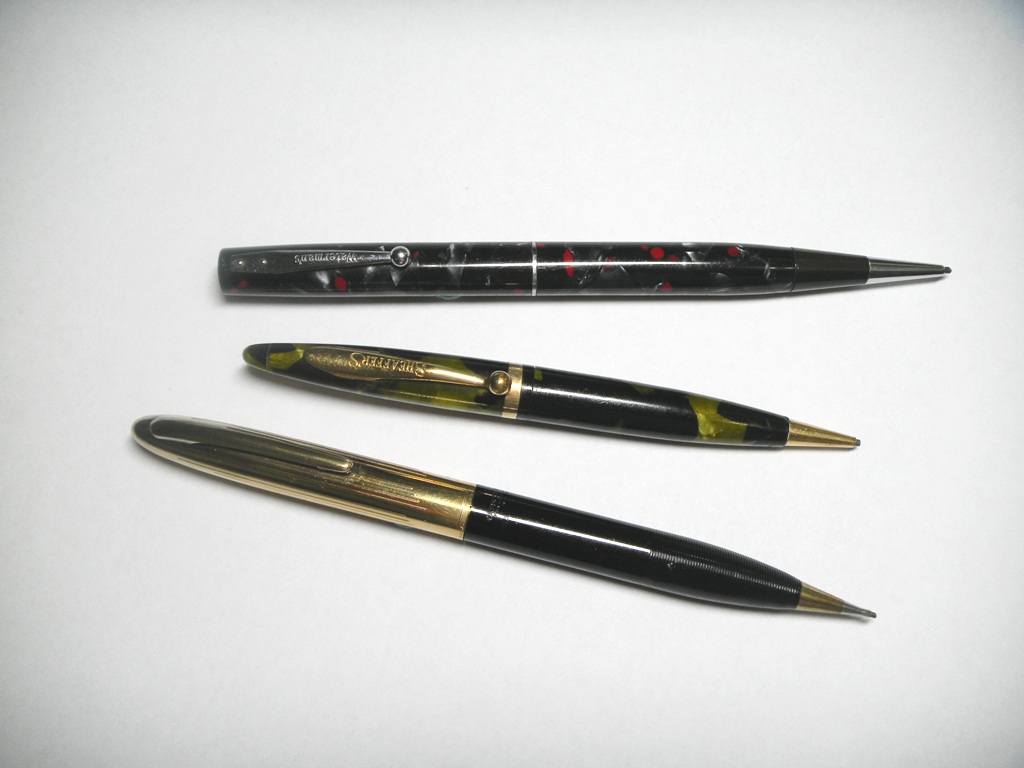
The other night I was cleaning a vintage fountain pen-and-pencil set that I wanted to sell. It was a 1930s Marine Green Sheaffer Balance mismatched pair - while the fountain pen was the standard length, the propelling pencil of the same pattern was shorter, sized for a vest pen. (I originally acquired them together, from the Fountain Pen Network Classifieds section a few years ago. Since then I was able to find a White Dot version in the same celluloid, so it was time to pass this pair on.)
I find that for some enthusiasts, the vintage pencil is an afterthought. Not many actually use the pencils as much as they would the fountain pens. Sellers sometimes break up sets in order to more easily sell the items. Maybe that's how my little vest pencil got orphaned, and later matched up with the wrong size pen. Some people, on the other hand, end up collecting vintage pencils for their beautiful celluloid (unblemished by latex sacs or staining ink).
Propelling pencils are writing tip-loading twist action pens. To expel old lead, you twist the pencil clockwise to push the lead upwards and out. Then you twist the other way until the metal pin that pushes the lead is fully retracted. You place the appropriate size lead in through the pen's nose cone and press the protruding tip onto the paper to make sure the lead is securely lodged. If you're not sure how to load your pencil, the blog Dave's Mechanical Pencils gives instructions, according to brand and era.
It was while learning how to refill the pencil that I realized it contained the wrong size lead. It was a 0.9mm lead that kept falling out. I cleaned out residue from the nose cone with a straight pin and tried some vintage Scripto 1.1mm lead that a friend gave me. It was a perfect fit! By the end of that exercise I realized I had fallen in love with the tiny pencil and just decided to keep it.
Richard Binder mentions that vintage Sheaffers and Parkers usually use 0.9mm leads, but not in this case. Pendemonium is another good source for vintage leads (the site navigation is not that intuitive, but go to Pen Repairs Supplies and select Pencil Leads). The most common sizes sold locally are 0.5mm and 0.7mm leads for modern mechanical pencils, but 0.9mm is available if you look for Japanese or Korean pencil brands (I use MonAmi).
I couldn't resist checking out the Waterman Ideal No. 3 propelling pencil that I received as a gift last January. I took it apart and discovered that the cap end unscrews to expose the eraser. I heard pencil lead rattling inside the eraser tube, so I pulled the eraser tube out and found a stash of short 1.1mm leads! The nose cone twists to propel the lead, but there wasn't much traction, so I lined the mechanism with a bit of latex and gently turned it with my pliers. I'll see later if a layer of dried shellac can thicken the diameter of the brass tube and provide traction for the nose cone (no, I'm not gluing them together). I'm not using the vintage eraser on this one - I have my favorite modern eraser (Staedtler Mars Plastic) for that.
For most daily use my 1940s Sheaffer Crest pencil with 0.9mm lead is pretty good. It's part of a set, too. I do have a couple of other modern plastic mechanical pencils, but right now they're not getting that much attention. The pretty vintage celluloid and the solid build appeal to me. It's not a collecting direction I'll be taking, but I sure do appreciate the fact that they're decades old and still work!
To learn more about vintage pencils, check out Jon Veley's The Leadhead's Pencil Blog. Jon Veley also wrote the book The Catalogue of American Mechanical Pencils and maintains The Mechanical Pencil Online Museum.
Posted by The Gravelcat at 9:56 PM 0 comments
Labels: Hobbies and Crafts, Mechanical Pencils, Vintage, Writing Instruments
Tuesday, February 5, 2013
Three Pelikan Tortoises
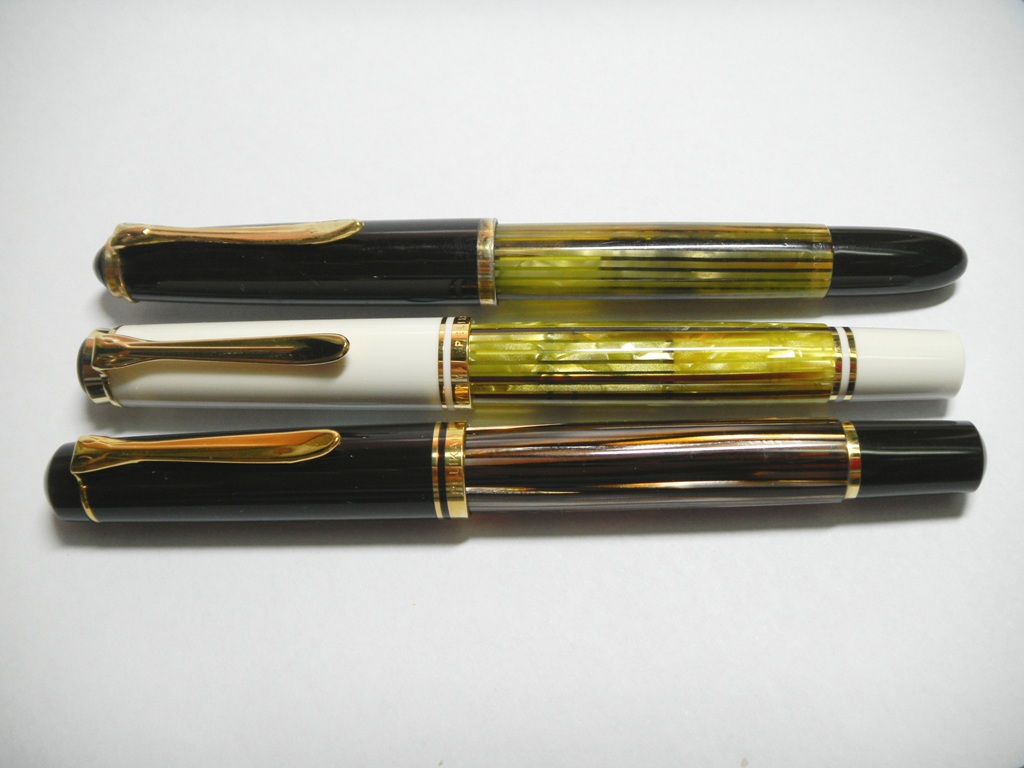
Back in 2009 I was trying to decide on a birthday fountain pen. I'm a Pelikan fan, and decided that I would save up for a Pelikan M400 White Tortoise with an F nib. It had just been reintroduced as a regular (and no longer limited production) pen. Prior to this my Pelikan flock was limited to M200s and M215s. It's the same size as an M200, only with a 14k two-tone nib. I got it for a good price brand new from a Singapore-based seller, and was delighted to see how pretty it was. Of course, since it was white, I read up on what inks I could safely use it with. For this I use low-maintenance blues, greens, browns and blacks (nothing red or purple, to avoid possible staining). To date it is my prettiest, blingy-est pen.
Last year my friend Hazel was streamlining her collection and put up her Pelikan 400NN Brown Tortoise for sale. I took a deep breath and immediately went for it. It's a 1950s model with a brown cap and piston knob. The tortoise stripes are mostly green, with a few brown glints here and there. The nib is a soft M, which I had gently stubbed by my friend J. P. so it would write with a bit more character. At the base of the pen there is an almost invisible imprint "Pelikan 400 Gunther Wagner Germany". The cap clip is a little brassed, but it is a pre-loved pen after all. I wasn't too worried about maintenance, since the 400NN pretty much had modern parts (no cork to replace on the piston). All it needed was for me to lubricate it, and that was easily done with a bit of silicone grease.
Top: Pelikan 400NN Brown Tortoise Middle: M400 White Tortoise Bottom: M250 Brown Tortoise
Now all I needed was a newer M400/M415 Brown Tortoise. The chances of finding one at a price I could afford were slim, until my friend Onggie showed me one of his eBay scores. "Hey, if you get tired of that, will you think of selling it to me?" I joked. Little did I know that a few months later I'd actually get to own it, at its eBay acquisition price! Of course when I saw it again, I realized that it was not the M400/M415 I thought it was, but the simpler and equally attractive M250 Brown Tortoise, a pen briefly issued by Levenger in 1997. I identified it by the cap, which is domed with an engraved logo filled in gold, and has a double cap ring that says "Pelikan Germany". The M400/M415 should have a double cap ring that says "Pelikan Souveran Germany". Also, the M250's piston knob does not have a ring, while that of the M400/M415 has a double ring. As with the 400NN, the M250 Brown Tortoise has a brown cap and piston knob. My pen sports an old-style monochrome F nib.
Writing sample. (Click photo to enlarge.)
There is a special edition M600 version of the White Tortoise. I love the size, but not the price. The M415 Brown Tortoise, also a special edition, is out of my budget, as is the much-rumored M800 version. The M101N Tortoise is lovely and is, alas, out of my reach. That won't stop me from admiring them, though.
I'm quite happy with my Three Tortoises.
Posted by The Gravelcat at 3:34 PM 0 comments
Labels: Fountain Pens, Hobbies and Crafts
Sunday, February 3, 2013
Buying Fountain Pen Inks in Manila
More and more people are growing interested in using fountain pens here in Manila, as evidenced by the growing membership in our pen group Fountain Pen Network-Philippines. For a long time Parker, Waterman, Cross and Montblanc were the only brands readily available in the local fountain pen market. Now there are new brands available: Lamy, Pelikan, Sailor, to name a few. Waterman,Aurora, Cross and Rotring are now no longer being sold here, while Sheaffer recently reintroduced itself. The local Pilot distributor sells only school pens, not the fine writing instruments, nor the ink.
I've compiled a list of stores that sell fountain pen inks, in bottles and cartridges as of 2013: (click on links to see directory info)
National Bookstore branches
- Parker, Lamy, Sheaffer, Inoxcrom (cartridges)
Montblanc branches - Makati (632) 813-3739, Powerplant Mall (632) 898-2347, Shangri-la Mall (632) 633-4636, Manila (632) 521-1140, Robinsons Place (632) 551-2095, Ayala Town Center (632) 850-5532
Scribe Writing Essentials - 3/F Eastwood Mall, QC. (632) 900-0053.
- Herbin, Lamy, Sailor, Pelikan (4001 and Edelstein)
Cutting Edge (Greenbelt 5)
- Waterman
Times Trading
- Lamy
As of this time, there are no local distributors yet for Noodler's, Diamine, Rohrer & Klingner, Aurora, Visconti, De Atramentis, Pilot (regular and Iroshizuku), Platinum and other popular brands of ink. For these, we resort to buying from eBay or online stores based overseas.
Posted by The Gravelcat at 9:20 PM 0 comments
Labels: Fountain Pens, Hobbies and Crafts, Retail Therapy
Thursday, January 31, 2013
Tinker, Tinker
Everyone who's ever had a hobby has tried to learn as much as they can about the things that sustain their interest. I love writing with fountain pens, so I've managed to learn enough about them to maintain them, thanks to sites like the Fountain Pen Network, Pentrace, FPGeeks, among others.
I enjoy cleaning my pens, too. It's a kind of meditation in itself, whether manually, with a nasal aspirator or syringe, or with an ultrasonic cleaner - that's all good. I recommend this article, written by a friend.
And then there are times when some pens don't behave the way they should. At such times I am filled with a combination of annoyance and curiosity, and a hunger to make things work. I want to tinker, but of course one must be an informed tinkerer. I don't want to void a warranty, so I need to do research. It's not an inconvenience because I'm an enthusiast after all, and it's an opportunity to learn something new. When I finally get my misbehaving pens to write right, there's this incredible geeky rush!
We don't have fountain pen repair persons in the Philippines, so I must be able to do some basic repairs confidently enough to maintain my own pens. Twice this week I've been plagued by dry writers, and was able to resolve one issue on my own (and got customer service for the other).
So far I've learned how to pull out and reset friction-fit nibs and feeds (only when necessary). I've flossed tines with a piece of acetate to make the ink flow a bit wetter. I've smoothed scratchy nibs with micromesh. I can resac vintage lever-fillers (Esterbrooks, Watermans). I've learned how to disassemble and reassemble a piston-filler (TWSBI 530/540), also to lubricate those that I can't disassemble totally (Pelikans, Lamy 2000). I've managed to fix a Sheaffer Imperial (touchdown), so my other ambition is to repair a Sheaffer snorkel. Of course these links I've provided aren't enough, one must read as many sources as possible. I've been lucky to have more experienced friends demonstrate how certain repairs were done.
Do you enjoy tinkering (with fountain pens, cameras, cars, anything)?
Posted by The Gravelcat at 6:25 PM 0 comments
Labels: Fountain Pens, Hobbies and Crafts
Wednesday, January 30, 2013
Waterman's Ideal No. 3 Set
Some Saturdays come with a happy surprise. A package arrived for me last weekend! A good friend from the US sent over a combined Christmas and birthday gift in the form of a vintage Waterman’s Ideal No. 3 set of fountain pen and matching propelling pencil! It came complete with an original Waterman’s box, complete with paper insert of instructions on how to fill the pen and pencil correctly.
I could not stop staring. The celluloid was beautiful! The pen is pristine – the clip and lever are absolutely clean and shiny, the Waterman’s imprint on the barrel strong and easy to read. There are no major use marks. It’s been resacced, ready to fill and write with. The pencil still had its original eraser, and contained the right size lead!
When I removed the pen and pencil from the box I was delighted to discover a pencilled inscription: “Frank Jr. Christmas 1941 Annie Carrisa Edna John.” I like to think this was a gift to Frank Jr. from his siblings.
The paper insert mentioned a patent date of 1932, so the date of manufacture could’ve been close. (Later, my friend, a member of the Pen Collectors of America, discovered the very pen listed in a 1933 Waterman’s catalogue. The beautiful silvery-grey swirls in a black matrix with random red flecks is a celluloid pattern simply called “Black Pearl”.)
The nib is a sweet 14k no. 2 flexible fine. My friend tuned the flow to be able to write well under a light hand, and to be wet enough to handle flexing. I haven’t really tried any sustained Copperplate-ish writing with it yet, but I feel it can certainly used that way. (I’d say my Wahl and Swan pens have slightly softer flex nibs.) I did try a fancy capital W in my writing sample, however.
This pen and pencil set was acquired from an antique store sale. Back in the 1933 people paid USD 3 to buy this fountain pen. It might have been a bit more when it was given to Frank Jr. Vintage Waterman’s Ideal pens come from the time when the brand was still American and American-made – about 1884-1954. (Now owned by Newell Rubbermaid, today’s Waterman fountain pen brand is based in France.)
I have inked it with Cross Blue and intend to use it often – which is the best way to honor such a wonderful gift. And the best way to start the New Year!
Posted by The Gravelcat at 1:42 PM 0 comments
Labels: Fountain Pens, History, Hobbies and Crafts
Saturday, March 10, 2012
Wheatgrass for the Guinea Pigs

At the end of February, my sister Joy started a new project - growing wheatgrass for our pets Moonball and Walnut. We live in a condo building, and usually have a hard time getting fresh grass. We do mostly small container gardening in the balconies. We give our guinea pigs some inexpensive leafy vegetables, but they're not a substitute for fresh, sweet grass. So Joy did her homework, and discovered a very good tutorial on SproutPeople.org. There are also many blogs that have excellent how-to videos and directions as well.
It was a challenge finding the seeds. At first Joy went to a feed store and bought oat groats, but only a small percentage of that sprouted and grew. She later remembered that Healthy Options Shangri-la had a selection of organic grains for sale. She found some Bob's Red Mill brand "Hard Red Winter Wheat Berries" and "Hard Red Spring Wheat Berries" which were being sold for P169 per 2-lb pack. Oddly this was a better price than what was being offered at Manila Seedling Bank.
The grains are soaked (and drained, and soaked, and drained) for anywhere from 8 hours to 18 hours. They are later spread on potting mix or shredded newspaper in small recycled take-out containers, and left to grow, covered, in a dark area until they sprout and etiolate (grow pale grass shoots without sunlight). After some time the shoots are transferred to an area with indirect sunlight, and the grass shoots eventually turn green. They are spray-watered several times a day. By the time the grass reaches 5-7" it is ready to harvest. Joy does staggered plantings so she has a harvest every day, or every other day. A serving of wheatgrass in a low take-out tray is enough to feed the guinea pigs - it's only meant to be a treat, since they have pellets for daily sustenance.
One day instead of cutting the wheatgrass and putting it in a bowl, we decided to give Moonball and Walnut the entire tray. They loved it!
The mowed-down grass, root system and potting mix are then shredded and returned to our little compost bin for later re-use. We've tried growing some wheatgrass in A4-sized low plastic containers for wheatgrass juice, but the yield was quite low - after a spell in a Jack Lalanne juicer, we only produced about 5 oz for 2 containers' worth of grass! We fed the discarded grass from the juicer to Moonball and Walnut, so nothing was wasted. That was worth a try anyway :)
Posted by The Gravelcat at 2:51 PM 2 comments
Labels: Family, Hobbies and Crafts, Pets
Thursday, October 27, 2011
Lilo's Halloween Costume
My 6yo niece has a very vivid imagination. She's wanted to be Medusa for the longest time. Last October 22 she had her fantasy realized - thanks to Mommy Joy's crochet skills. Joy found the free crocheted yarn snakes pattern by Lucy Ravenscar at Craftster.org.
The 14 snakes are made up of combinations of yarn colors, crocheted over four days. The eyes and tongue are sewn on. They are attached to a plastic headband, along with black yarn "hair". The "black" lipstick is eyebrow pencil rubbed over lip gloss. The rest of the costume was a black sleeveless dress.
Lilo was even more thrilled when she won a special award for her costume! Even now she's thinking of a new costume for next year...
Posted by The Gravelcat at 1:22 PM 0 comments
Labels: Family, Hobbies and Crafts
Wednesday, October 12, 2011
Attempt At Coptic Binding
It's been a couple of years since I did any bookbinding projects. My last one was full-on hardcover bookbinding (with glue). Last weekend I decided to try Coptic binding, which is a sewn binding that does not require any adhesives.
I once attended a seminar on bookbinding, but it didn't include coptic binding. I knew how to do kettle stitch, but not how to attach the cover boards correctly. So I browsed tutorials on Youtube. I found DaphLife's tutorial friendly and easily followed.
I did two practice books, a "pocket-size" book (a page is half a legal-size sheet folded into two) and a "standard" (letter-size sheet folded into two) one. They're quite minimalist; I didn't cover the illustration board covers with fancy paper anymore since I was impatient. Besides, I was only going to use them for ordinary note-taking and not for journalling. I'm frustrated that I can't find in the bookstores quality bulk paper whose surface can take fountain pen ink properly enough that I can write on both sides of the page. At least my book block paper is acid-free. Next time I'll do the fancy cover wrapping and all.
Coptic binding usually requires a thicker thread, usually of a color that contrasts with the paper and the cover board. This makes sure the decorative aspect of the sewing comes through to the viewer/user. I just used what I had at home, a 100% cotton crochet thread. I used the single-needle version (yes, there is a two-needle version, but I only had one needle big enough for the crochet thread).
What I like about this method is that the book opens flat, is stackable (compared to my comb ringbound notebooks) and is 100% biodegradable.
Yes, yes, I know, next time I'll make prettier wrapped cover boards.
Posted by The Gravelcat at 3:42 PM 0 comments
Labels: Bookbinding, Hobbies and Crafts
Friday, October 7, 2011
EPP Balcony Herbal Garden
Click on the photos to enlarge.
This is my mother's EPP herbal balcony garden: organic sweet basil, bok choy, Himalayan spinach, tarragon, rosemary and chives. Yes, the planters are converted plastic Coca-cola liter bottles.
EPP stands for Enriched Potting Preparation, which uses a "nutrient-rich compost soil extract, in a watering and aeration-efficient container". It's award-winning urban garden technology developed by Dr. Eduardo P. Paningbatan, a professor of soil science at the University of the Philippines in Los Banos.
My mom attended one of his seminars and decided to start her own garden. She even organized a seminar at our Metro Manila condo complex so that other unit owners could grow their own organic and pesticide-free herbs and vegetables, even ornamental plants.
EPP is distributed by:
Makiling Plant and Products Exchange (MPPI)
10001 Mt. Halcon St., Umali Subd., Los Banos, Laguna
Tel No. +6349-536-0054
Fax No. +6349-536-5536
Mobile +63919-804-7169
Posted by The Gravelcat at 1:10 PM 0 comments
Labels: Family, Hobbies and Crafts
Friday, May 6, 2011
Three Purple Herbin Inks
I recently blogged about my three green J. Herbin inks, a comparison review that was posted on the Fountain Pen Network. This time I thought I'd compare my three purples - Poussiere de Lune, Larmes de Cassis and Violette Pensee. This is one occasion when the labels on the bottles closely match the actual color of the inks.
Poussiere de Lune is a dusty purple with grey undertones. It's a dignified, elegant color, a good alternative to black and blue-black. Karen Doherty of Exaclair, Inc. very kindly sent me a bottle for review (along with Lie de The). My US-based cousin Jasmin also gave me a bottle, which she purchased at a neighborhood stationery store on the strength of it being a bestseller.
Larmes de Cassis, on the other hand, struck me as a romantic, old-fashioned color. It's not strictly a purple, but I'd classify it as a related color on the pinkish side. In my Waterman 32's EF nib it comes out as a pale berry pink. In my Parker Lucky Curve's EF nib it writes a darker, richer color. I guess it depends on the paper. It looks great on cream-colored paper. It also appears darker on the more absorbent papers. Larmes de Cassis also shades very prettily depending on the nib used.
Violette Pensee is the classic blue-purple ink used by generations of French schoolchildren, and evokes the color of the pansy. It comes out of the nib purplish, but dries bluer. It's a beautiful, bright color that's appropriate for most writing situations. This was the very first bottle of J. Herbin ink I ever bought.
All this ink reviewing just adds to my irrational desire for more ink, if only it didn't deplete the wallet so much! When Cafe des Iles becomes available at Scribe Writing Essentials, I'll review it along with Lie de The, to show the difference between the two brown Herbin inks. The third brown, Cacao du Bresil, does not appeal to me as it's an odd brownish-grey.
J. Herbin inks are available in the Philippines at Scribe Writing Essentials (3/F, Eastwood Mall, Libis, Quezon City) and the Scribe stall inside Powerbooks in Greenbelt 3, Makati. They come in 30ml "demi-courtine" bottles, at PhP 495 each.
I am not affiliated with Scribe, am just a happy customer.
Posted by The Gravelcat at 4:36 PM 1 comments
Labels: Fountain Pens, Hobbies and Crafts
Monday, April 11, 2011
Platinum Mix Free Inks
Platinum Japan is coming out with a line of fountain pen inks that can be mixed with each other to produce other colors. There are 9 basic colors: a black, 2 blues, a purple, a pink, a red, a brown, a yellow and a green. The picture above shows you the many possible combinations. Alas, I can't read the information on the Platinum website, which is in Japanese. According to the Fountain Pen Network forums, the inks haven't reached interntaional distributors yet. The inks are supposed to be waterfast. (Comparable Japanese ink lines are the Pilot Iroshizuku series or the Sailor seasonal inks, only these inks are specialty colors not meant for mixing.)
Maybe one day soon one of my more intrepid friends will not be able to resist and may come up with at least 4 of the 9 basic Platinum Mix Free inks (CMYK, anyone?). The ability to mix new colors would be such fun.
[Note: Where to get fountain pen ink in Manila: National Book Store branches have the ubiquitous Parker, Waterman and Cross inks. The Montblanc boutiques, of course, sell their own ink. Scribe Writing Essentials in Eastwood City has the French J. Herbin inks and the German Pelikan Edelstein line. My fellow fountain pen lovers and I have a few inks from these sources, but have also tried eBay, online shopping or asking friends travelling abroad to buy other well-known brands for us. I am not affiliated to these outlets, but mention them as a guide for the interested.]
Posted by The Gravelcat at 5:11 PM 0 comments
Labels: Fountain Pens, Hobbies and Crafts
Tuesday, June 23, 2009
Making Books
I used to think that one day I'd write a book. Somehow I never made the jump into longer narrative fiction, as I woke up one day complaining of how work killed my creativity. I still haven't written a publication-worthy poem since I left Australia, but I did wake up another day to realize that creativity extended to what I could make with my hands.
You all know about the knitting and how it forced me to use Math. I'd say that's karma, since I chose a college course on the basis of what I did well and how few Math subjects were required, haha.
Now I'm binding books by hand, after taking a course with paper artist Loreto Apilado last May. I always thought Moleskines were the kind of thing I'd never leave home without. In the pre-Moleskine days I lugged around a Philamlife black diary, in which I wrote, colored and pasted everything that made life more interesting. I didn't know that would be called journaling and collecting ephemera today. The black diary had really bad paper, although a Pilot 55 with a Japanese fine nib worked well on it. I kept nine years' worth of journaling in them, enough to fill a small baul (a mother-of-pearl inlaid chest my mother gave me when I turned 18).
My particular favorites were the Toyo Rock Drill engineers' notebooks that my dad brought home from Japan. Not only did they have the best paper, they also LAY FLAT when opened. There was a major section with unlined paper and a smaller section in the back with grid-lined paper. The pages were smooth and somewhat coated, perfect for fountain pens, without bleedthrough or feathering.
I kept thinking of this when I learned to make books. Moleskines are ridiculously priced, and the paper quality is uneven. If the only pen I can use on it is a Lamy with an extra fine nib, that would mean my other pens would go relatively unused! I did go around and tested different brands of papers, and found some that fit my requirements: smooth, no feathering with a wet medium nib, no bleedthrough. Since I do support a number of fundraising projects, I thought my blank journals would make a good charity bazaar item. They make splendid gifts people would actually use (well, if given to the people who appreciate these things).
So this month, after scouting around and accumulating materials, I was finally able to make two hardcover blank books with ribbon markers, one each for my good friends Jenny and TAO. It's good that I hadn't forgotten how to make the books since May. I tried as much as possible to make them look neat but they do retain hallmarks of the handmade (the deckle edges remain untrimmed, there are a few non-obvious glue bubbles that bug me, etc.). The very first book I made, the product of the workshop, is now being used as an "ideas" journal for my knitting and binding.
May and Reg's books are next up for production. May made me a gorgeous silky pen wrap and I'm making her a book in exchange. Reg's is a belated birthday gift. I'm also raffling off a couple of journals at the FPN-P Anniversary Pen Meet in July. Then I'll maybe try exposed-spine binding. Ambitious, but when I get it done, you'll know. This year is full of creative opportunities.
Posted by The Gravelcat at 9:55 PM 0 comments
Labels: Bookbinding, Books, Hobbies and Crafts
Saturday, May 30, 2009
My Very Own Handmade Hardcover Journal
Today, on the third of a three-Saturday classical bookbinding workshop, I finished this. It's 192pp, with a cranberry-colored Philippine handmade paper cover and a yellow bookbinder's paper spine.
Don't mind the dark blots on the left-side endpaper. That's archival glue that hasn't dried fully yet. This is also Philippine handmade paper. The swirls are made of paper as well - it's NOT a print. I believe this paper was made in Batangas although it is being sold at the malls or in National Bookstore, in different color varieties.
The pages open flat, which is what I love about sewn bindings. We used lock stitch. I love how neatly I was able to do this. (One day I will learn Coptic stitch.)
Next time I will add a ribbon page marker. I also want to try a smaller format, like a pocket-size journal.
Some of my classmates are librarians, but some, like me, wanted to learn how to make pretty and useful things. This three-day workshop was held on May 16, 23 and 30, at the Lopez Museum in Ortigas Center, Pasig City. Paper artist Loreto Apilado, our teacher, is conducting a Book Repair workshop soon. I want to study that too!
For more details on activities at the Lopez Museum, visit their blog.
Posted by The Gravelcat at 3:53 PM 0 comments
Labels: Bookbinding, Books, Hobbies and Crafts